
Mass balance and process simulation for water management in mineral processing
Water is everywhere in a mineral processing plant. It carries solids, hosts chemical reactions and leaves the site in products, tailings and effluents. To manage it, a plant first needs a water balance it can trust. Data reconciliation turns raw measurements into one consistent set of flows, and simulation then tests new scenarios on top of it. This paper, presented by Etienne Braak at SIM 2026 (French Congress of the Mineral Industries Society, Châlons-en-Champagne), shows how on real plant cases.
Key takeaways
- Water management needs a reliable water balance.
- The observed balance shows the plant as it runs today. Data reconciliation makes plant figures consistent.
- The predictive balance comes from simulation. It tests new configurations, such as more recycling, before any change on site.
- Together, the two balances link raw plant data to operational and strategic decisions.
Why water management matters in mineral processing
The mining and metals industry is highly dependent on water for its operations. Processes cannot run without water. Water carries the ore from one stage to the next, and it is the medium where flotation, leaching and reagent reactions take place.
Plants also need more and more of water. As ore grades fall, plants treat more tonnes of ore to produce the same metal. More tonnes means more water.
Since fresh water is not always available in sufficient quantities, plants recycle their process water. This recycling has an effect : it induces the build up of dissolved species and residual reagents, which can impact the process performances.
On top of that, three types of constraints weigh on the plant:
Withdrawal constraints
Water intake is limited by law and by what local communities will accept
Safety constraints
Water stored in tailings facilities must be kept under control
Environmental constraints
Discharges must meet volume and quality limits
Water balance frameworks
A water balance is not asked for in the same way everywhere. A plant team uses it to run the circuit, a company uses it to compare its sites, and investors read it in sustainability reports. Each of these stakeholders works with its own framework, and each framework has its own scope, level of detail and frequency. All these frameworks share one thing: they are based on a water balance. The table shows the main ones, level by level.
Site water management
Internal monitoring; Global Industry Standard on Tailings Management (GISTM)
Run the site, secure tailings facilities
Company water management
Report water inputs, outputs and recycling in a consistent way
Corporate sustainability
Disclose water performance to investors and stakeholders
Plant or unit operation
Process engineering studies
Optimise a circuit or a piece of equipment
From mass balance to water balance
Water accounting means tracking every litre that enters a site, moves through it and leaves it, with its quality. To be reliable, it needs a water balance.
The principle is the same as for a solids mass balance. At each node of the flowsheet, what goes in comes out, give or take a change in stock. This applies to each mineral, each element and each volume of water.
The difficulty is the data. Plant measurements are associated with an uncertainty, so the balance does not close. Data reconciliation fixes that by correcting each figure within its uncertainty, with the largest corrections on the least reliable measurements.
However water balances raise difficulties that mass balances rarely meet. The paper explores why with a real plant case.
Still, for a site-wide water reporting, a quantitative balance on a simplified flowsheet is enough. A balance on a detailed flowsheet needs more assumptions, this is where simulation takes over.

USIM PAC process simulation software
Water management flowsheet ITERAMS project
From observed to predictive balance: process simulation
1. The configuration of the simulator for water balance
CASPEO’s simulator, USIM PAC, combines five elements:
- The plant configuration, as a flowsheet
- A description of the material: minerals, particles, water and dissolved species
- Models of each unit operation
- Input data, which define the scenarios to test
- A set of calculation algorithms
USIM PAC delivers a predictive mass balance, the sizing of unit operations, and energy costs.
2. Modelling water in a process simulation software such as USIM PAC
A simulator handles water on four fronts:
- Solid/liquid separation models control water quantities
- Water treatment models control water quality
- The circuit tracks how water quality changes from stage to stage
- Process models link water quality to process performance
The last point answers the question plants ask most: what happens to recovery if we recycle more water? This point will be presented through two simulation studies: the first one with a long loop where process water is recirculated from tailing pond, the second one, with short loop, where water goes straight back after solid/liquid separation.
Mass balance and process simulation: what the tools bring to water management
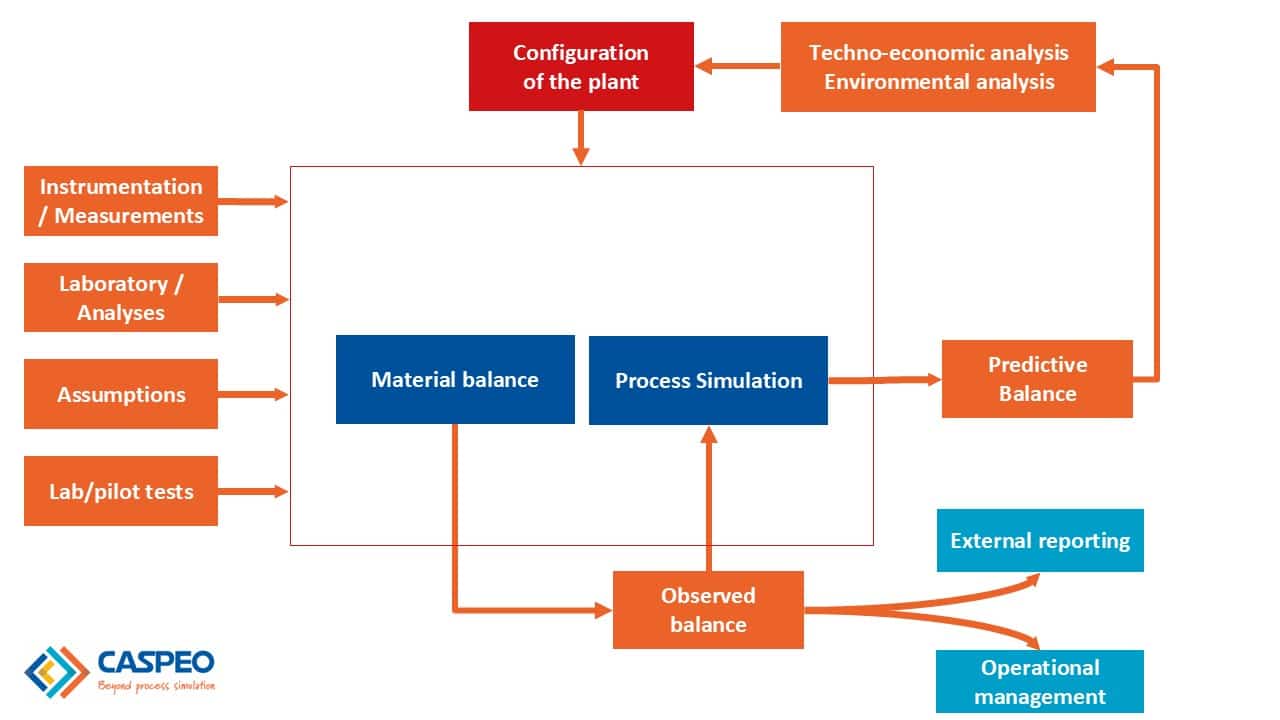
The mass balance gives the state of the plant at a given moment. That is the observed balance. Process simulation goes one step further and tests new configurations. That is the predictive balance.
The two tools connect raw plant data to higher level objectives associated to water management. Used together, they:
- Gather plant data and make them usable for decisions making
- Give a solid base to monitor operations
- Open up optimisation opportunities
- Improve risk management, for stocks and for planned changes in operating conditions
The paper presents case studies from real plants and the lessons we drew from them. It also looks at coupling simulation with life cycle assessment (LCA), as part of the Hydroshift project.
Authors
- Etienne Braak, PhD. – CASPEO
- Stéphane Brochot, PhD. – CASPEO
- Marie-Véronique Durance – CASPEO
Etienne Braak has presented CASPEO’s methods and tools for water management at the SIM 2026. The SIM congress 2026, the annual congress-exhibition of the Société de l’Industrie Minérale, the French mineral industry society, was dedicated to water: “Water: essential resource and strategic issues”. It has taken place from 6 to 9 October 2026 at Le Capitole, Châlons-en-Champagne. The paper is titled: ” Balance and simulation: tools for integrated water management in the mining Industry”.
Improve water management in your mineral processing plant with USIM PAC
USIM PAC is a steady-state simulator for mineral processing. One flowsheet holds the ore circuit and the water circuit, from crushing to refining. Change the recylcing rate and you see the effect on recovery, grade and water at the same time.
Discover how the built-in reconciliation turns your raw plant data into one consistent balance, the starting point of the simulation.
Frequently Asked Questions (FAQs) on water management in mineral processing
What is water management in mineral processing?
Water management in mineral processing is the control of water quantity and quality across the plant. It covers withdrawals, process water, recycling, water quality and discharges. It relies on reliable water accounting to set targets and measure progress.
What is a water balance in mineral processing?
A water balance is a quantitative representation of all water entering, circulating within, and leaving a mineral processing plant. It helps operators understand water consumption, recycling, losses, and storage throughout the operation. A reliable water balance is the foundation of effective water management, sustainability reporting, and operational optimization.
Why is an accurate water balance important for mining operations??
An accurate water balance helps mining companies reduce freshwater consumption, improve water recycling, identify losses, support environmental compliance, and make better operational decisions. As water becomes a critical resource for both production and ESG performance, understanding how water moves through the plant is essential.
Why is it so hard to close a water balance in a plant?
Water is the hardest stream in a plant to measure well. Much of the flow has no meter, and the meters that exist drift or read the wrong density. Water also leaves where nobody looks: it evaporates, leaks, or stays in the tailings and the concentrate.
USIM PAC works from the measurements you already have. It applies mass balancing and data reconciliation to them and returns one water balance you can rely on.
To note: the reconciliation engine is also available as standalone software, BILCO.
How can process simulation improve water management?
Process simulation enables engineers to evaluate different operating scenarios before implementing changes in the plant. With USIM PAC, you can simulate water recycling strategies, assess the impact of throughput changes, evaluate tailings water recovery options, and identify opportunities to reduce water consumption while maintaining process performance.
You still need tests on your own ore and water to get numbers you can trust. A steady-state model gives average conditions, not seasonal swings.
▶️ This article could interest you
Braak, E., Brochot, S. (2022) Water balance in mineral processing: interest of the metallurgical approach, SIM 2022 congress (France).
How does USIM PAC support water balance and water recycling studies?
USIM PAC models solids and water in the same flowsheet and in a single platform from crushing to refining. It allows engineers to build reliable water balances, analyze water distribution throughout the plant, evaluate recycling scenarios, and quantify the impact of water management strategies on both resource consumption and operational performance.
▶️ This webinar could interest you
Related articles
CASPEO at IMPC, International Mineral Processing Congress 2026
This year, the 32th the IMPC, International Mineral Processing Congress 2026 will take place from October 18-22, 2026 in Cap Town (South Africa). Come to discover CASPEO's sampling, data...
Using automated mineralogy data in process simulation with USIM PAC
Automated quantitative mineralogy measures the composition, size and liberation of hundreds of thousands of individual particles. Process simulation predicts how a plant will treat an ore. A...

CASPEO at the Congress of the French Mineral Industries Society (SIM) 2026
This year, the 75th Congress of the French Mineral Industries Society 2026 will take place from October 6-9 in Châlons-en-Champagne. Come to discover CASPEO's approach on water and wastewater...
Ready to talk about your project?
Question about your process, our process simulation software or services? Write us here to be in touch.
Subscribe to our newsletter

CASPEO provides process simulation software, metallurgical accounting solutions, and expert consulting for the mining and metallurgy industries worldwide. Through our integrated approach that combines statistical data analysis, advanced process modeling, and mass balance reconciliation, we help you build the data-quality backbone to improve efficiency, strength sustainability, consolidate governance, and succeed in your digital transformation. With CASPEO, go beyond process simulation.
Stay tuned!
Empower your decisions
Consulting
Engineering software
Get a quote
Develop your skills
Courses
Blog
Get a live demo
Need assistance?
Online support
Contact us
Site map
2026 © CASPEO - All rights reserved